The question makes me quiver with a strange kind of excitement. The anticipation of a power, handed to me on a platter. Like I am the most supreme, and that I have everything under my control. I can twist, tweak, mould and reshape what I want. Oh, what fun! But yes, also an enormous responsibility.
Is it not easy, I ask myself, with one sweep of a wand, to make everything peaceful and perfect? Then life would have no twists and turns, be one straight long road, and life would be one big party. There would be no need of a God to pray to, no police for want of protection, no religion for a feeling of belonging, no nations to feel patriotic about, no movements to fight against discrimination. Sounds so desirable, but is it practical?
The world was meant to be just the way it is. The imperfections, the injustices, the tyrannies of rule and mishaps. I believe that there is a purpose behind everything. And if there is chaos in this world, it is there to teach us something. To keep people moving forward, to mutate, to fit and to survive as evolution meant us to.
One single person in this world changing things would cause a feeling of dissatisfaction to a lot of others. Like a dictatorship. Because that is how we are made. Everything is relative. For every good, there is an evil; for every misfortune, there is a miracle; for every superstition, there is a rationalization and we all know that every human thinks in two radically different ways in any given situation.
If I try to make things better for one person, then I am bound to make someone else dissatisfied. Even terrorism seems to have another point of view, or it would not have survived this long!
So is everything hopeless? Is there nothing we can change? I believe that the change is something buried deep inside of us. This would be the place to target. For humans to understand that they are always not right, that every one step each one of us take can cause myriad ripples in multiple directions and so we must be careful. And that we should learn to care. About ourselves, our fellow beings, our environment and of things beyond that we do not understand as of now.
Caring, a lot of people believe can make us weak. The biggest decisions in this world were made with our heads rather than our hearts. But look where it put us. World wars, communism, the formation of countries, religion, the caste system, gender stereotyping, traditions – all of which were in the first place decided upon rationally to bring a semblance of normalcy to this world. But did they?
Therefore, I beg to differ. I feel that caring is the one thing which makes us strong, gives us foresight and wisdom to change what we can, fight when the need be and sometimes let go of things which cannot be changed. Every social evil, and environmental catastrophe that I can think of could have been changed if we had cared, rather than made-rules!
This I believe is the change the world deserves. So yes, if I could change one thing in this world, I would choose to inculcate the feeling, the thought and the attitude of ‘caring’ into every single soul living on this earth.
Then I would say, may the fittest survive. This is my world remade.
This post is a part of a competition that I am participating in.
Hello everyone.Every once in a while, there comes a time in my life when I suffer from a severe case of “exhaustion block”, diagnosed by the symptoms of extreme sleepiness whenever the computer is switched on and complete blankness of mind at all other times! The past two weeks, hence were used to read, both books and blogs, which sort of recharged my system.
One of the blogs which helped me out of my mental exhaustion is by an Australian called Phoebe(yes, just like the one from friends) called The Little Grey box. (I have not yet mastered the art and the science behind making a blog link open by somehow attaching the link in my blog, so you have to google it if you want!). She writes about travel and inspiration. It is how she writes about really philosophical things in a way that makes you understand what she means to say, that make the blog a good read. When down in the dumps, read Phoebe, has been my mantra the last two weeks! Then there is a cooking blog or website called the Edible Garden, which opens under the link www.cookingandme.com which gives you really nice recipes which are easy to make and the way the recipes are explained make you feel like as though the writer is speaking to you! So, I have also been trying out recipies in a frenzy!
Apart from this, I read a book called ‘All about Bacteria’ written by an Indian author Ravi Mantha. Got intrigued what someone could write for 230 pages about bacteria under the category of ‘popular’ non fiction. But the book is good. It is about the millions of trillions of bacteria which live in and around us and have been totally misunderstood as beings which out there to make our lives miserable! The book goes on to explain how all bacteria are not pathogens and that we needed quite a few to be healthy too. The bacterial symbiote is based on the premise that humans and bacteria have lived in harmony together for times immemorial, and only a handful of these bacteria cause us illness. Hence, just as a few bad experiences do not put us off the whole human population for good, a few illnesses should not make us believe that all bacteria are bad for us.
When we go through our MBBS degree, we go through a whole subject called microbiology which teaches us all about harmful bacteria and what damage it causes, and side by side we learn pharmacology which is almost manically dedicated to eradicating these pathogens. But nowhere in our training that I remember, were we taught about how to understand our body bacteria and work with them rather than against them for a healthier life! Have developed a new respect for these small creatures after this book (I know I sound weird, but its true!).
Apparently in China, till about a century ago, the village doctors who were given the charge of public health of an entire village, would be paid their monthly salary only if they managed to keep the whole village sickness free for the entire month! Great concept, right? The doctor hence needs to be a teacher, a community physician who also works a lot towards primary prevention rather than tertiary care. It also describes how the medicine we currently practice, is now more palliative instead of curative, hence giving rise to more resistant strains of bacteria and newer mutations of the older easier illnesses. The peanut allergy syndromes, the relation between peptic ulcers and obesity, how body defenses work and many more such interesting facts are explained really well.
Remember reading a similar book long ago called ‘The Survival of the Sickest’ written by Dr. Sharon Moalem. This book is all about why we need diseases to survive! Dr. Atul Gawande is another person whose books make me feel that medicine is all about thinking simple and logical. He makes the most simple statements, but they make such a big difference to the way we function in hospitals. I felt my work exhaustion dissipating and some new energy creeping in!
The aftermath of this was that I got so hyper interested in reading similar books and ordered a whole lot of them online and am waiting desperately for them to arrive! Will keep you posted how they are! Till then, have a happy weekend with your family and your body bacterial symbiotes!!
Let me confess at the outset, that I do not even know whether I am qualified or deep enough to write this piece. My defense is that there may be an equally large number of people out there who feel like me, and are also not completely well read in all matters history, religion or politics. And I also confess that being a mother, I tend to dwell a lot on the premise of what kind of a world is it that I am letting my children wander into?A world where you have to be scared of belonging to a faith? Or one where you wear it like a badge!I feel it needs to be neither.
This year has been all about a feeling of unease about religion. I have never big on either politics or religion, but this year has pushed me into thinking a lot about it for various reasons. A few to be mentioned are- the recent spate of killings by the ISIS, a few videos that I watched on whatsapp of a close up of beheading done in cold blood in some Arab country, “Aavarana”, a book by S.L. Bhyrappa that I read with mixed feelings, a few statements made by our seers which claimed that Hindu women needed to procreate with greater speed and intensity to save our religion and finally culminating with an experience that I had this afternoon- a ‘Pathasanchalana’- a march of thousands of RSS swayam sevaks held in my hometown.
Growing up, I was brought up in a family which held our country’s values of democracy and secularism in high stead. My home town, though rich in history was not too communal. And the street I lived in had people belonging to almost all religions and caste. Hence, the idea that something really deep could divide us only struck me during the Babri Masjid riots. I remember huddling in my school waiting for someone from home to come and pick me up. I also remember the fear on my Muslim friend’s face during the wait. It was a little more complicated for her. She was waiting to be taken home safely by someone hopefully arriving to pick her safely! After this, there was again a sense of peace which prevailed for the next so many years. Slowly, I pushed these disturbing memories to the remotest corner of my mind.
I have always felt that religion should be something very personal. Something which gives you a sense of peace, a feeling of security and belief that if something goes wrong,the Almighty(with a capital A) was there to protect you. And some place you send your prayers to. But why is it not so simple? Why do people then try to publicize it? Or propagate it? Probably because then you get the power of numbers? And then politics enter into it? And jumble it up further? And make you smile at people and want to stab them in the back at the same time? But still want to stick to the book and pretend to be a pious human being who does no wrong? And so many more questions that I have, which will fetch me more confused answers!
So I decided to read up (at least a little) about what drives these religions. And I came upon Aavarana, a book which sort of describes the history of Islam and the Mughal rule in detail. Lets say that it was not all complimentary to Islam, but the book does claim to have its research done from books written by Mughal rulers themselves. Which is the reason why, we can understand having a right wing which claims to set right these wrongs and protect the Hindus. And we have, in between all this, the British who tried to stay back and rule by dividing the already divided, further! And our politicians, who have tried to cash in on this divide, for votes. Now, how do we ever disentangle this mess?
Reading further and deeper into this topic is guaranteed to make you more and more depressed. There are so many avenues, nuances, dead ends and a general insensitivity which make the situation worse. Where do we start smoothing the creases? And revert back to the basic concept of getting comfort from your choice of faith? Because, now it scares!
Standing on the road today, watching the procession, I was eves dropping on the conversations going on around me. And generally observing everything going on around.Two women discussing the number of ‘holiges’( a sweet preparation) which were cooked for the swayam sevaks’ feast. A fully sozzled guy, trying to clearly voice out ‘vande mataram’. Two girls obviously tickled about his inebriated state and giggling away constantly every time he managed to get it right. A lady trying her best to edge into the front row, using her husband’s paralytic limb as an excuse. A policeman, trying his best to control an undisciplined crowd. Swayam sevaks in the march capturing images on their mobile phones. Two boys sitting on roof top, emptying Nandini milk packets on to a huge hoarding of Shivaji! Our grocery store, uncharacteristically being closed owing to the fact that it belonged to a muslim and there was a RSS march going on. Basically, life was going on as usual a midst all the hype about faith. This reassured me, that deep down, all that we want is food, a roof, some security and an opportunity to have some harmless fun.
Abraham Maslow, a psychologist, famously gave his pyramid of hierarchy of needs. The pyramid claims, that unless basic needs of food and security are met, you cannot move on to the next level , and later push yourself on to achieving self actualization- ‘nirvana’ in the end.
In this respect, we in India, at least vast majority of the population, are still grappling with stage one and two! Then why should we confuse issues, instead of providing for the first two levels?
Why should we inculcate religion like a discipline, rather than teach our children to grow into a faith of their own creation? Based on what is needed for the day, rather than what had happened many hundreds of thousands of years ago? Some place where the need of this day is discussed, rather than vengeance? Where we can discuss religion freely, rather than impose it upon others or worse, behead them?
History tells us about how different faiths have tried to come up each, by putting down the other. Why not make it better now rather than ruffle feathers?We have always been taught that all religions are good. lets now learn to accept the fact that there is some bad too. And move on.
I know that this post contains more questions than answers. It is because these questions have been there for a long while without finding answers that pacify me. And leaving me confused as to what I should be first- a mother who teaches secularism, a hindu (just because I happen to be born one), who upholds ideals dealt out by our seers, an Indian or just simply, plain old me????
Monali is the name of the fifteen year old girl who committed suicide in Bengaluru yesterday.She chose to take such a drastic step because she was suspended from school for inappropriate behavior. The behavior that was so labelled, included apparent PDA with a boy in school whom she was warned against earlier.
Almost every single day in my practice, I see Monalis of varying age groups and backgrounds, but brought for counseling with similar problems. That they were on varying levels of intimacy with boys of questionable reputations, and excessive usage of mobile phones. The parents are angry, defensive and would have tried everything in the book from scolding to physical abuse to emotional blackmail till nothing works and they decide to try counseling as the last resort. Schools take to vigorous punishments, strict rules, dress codes, lectures and seminars proclaiming the importance of our RICH Indian tradition which does not accept such interactions (but by the way, somehow chanced upon the kamasutra!) and many more such ‘disciplinary’ measures.
Whenever I read newspaper reports of such incidents or watch the Breaking News on prime time, I always wonder why we do not try to understand how such drastic rules came to be a part of schools in this age and time? After all, teenage crushes did not originate in this generation, and have been persisting from the time I remember going to school and probably earlier too. And handling such situations should have got better by practice and with time. Just like how we learn to deal with an irritating co worker or a pestering relative. You worry, you try but finally accept and get used to them and hopefully handle them with just the right amount of maturity. Why hasn’t that happened with such situations?
The most common answer that I get for such a question is that children now, are very precocious.That they would not think twice before taking the relationship further(by which I mean, to the physical intimacy level) and lose track of studies. True, but this again is something you have to accept,get used to and change slow and steady. With the right amount of concern and finesse. By trial and error. By guiding rather than pushing. By asking rather than assuming (the worst).Just the way we got used to any new change like the television, internet, cell phones and globalization, which we have no qualms about embracing, but needed trial and error to tell how much of it was just right. Not by bull dozing our concerns as didactic rules.
Whenever I have interacted with teachers of children with behavioral problems, the primary emotion the most teachers express is one of fear rather than care.Fear that if something goes wrong, the responsibility will land squarely on their shoulders! The reason for this is the change in quite a few parents’ behavior whenever something is not happening as per their expectations. From issues such as not doing well in academics, to having bad friends to falling in love and elopement -all of which become the school’s responsibility. When parents do find fault, then often do it vociferously and drag the media along, who add a generous dose of sensationalism to the whole deal. And they are often looking to put the blame squarely on any one person’s shoulder. The person whom the complaint is against-which most often is the teacher or the school. I am sure, if the teacher in the above incident was asked why she/ he dealt out such an illogical or unwarranted punishment, this is probably the reason they would give you. It is NOT that I support what the school has done, but rather than just blaming the school, I think we should find out solutions so that this this does not happen again.Because after a while, Monali’s memory may fade, but the illogical rules will remain.
We live in confused times. We teach our kids to feel free to make friendships, but worry if they do make friends with the opposite sex; we teach them that they can share everything with us but become judgmental if they do share something which does not belong to our school of thought; we show them movies(and also often watch enthusiastically alongside) of how a couple goes against the world, falls in love and gets married to live happily ever after, but do not allow them the same yardstick to choose their spouse. We still do not discuss sexuality or growing up freely in our households. Instead, we spy on our children and give veiled warnings of what they would face in case of a bad grade or a bad boyfriend or both! Sex education gets a negative connotation, and hence, schools are wary of practicing it. We do not have clear cut reasoning to define why we are enforcing certain rules or the validity of it. Like why girls and boys are made to sit separately in high school or how banning girls from entering college libraries (as in Aligarh Muslim University) will prevent inappropriate behavior and increase grades!
There are hardly any school counselors whom the child can open up to, and most are worried whether discussing their love life with a counselor would actually be wise. Just this morning, an article in ‘The Hindu’, discussed the constraints students face when talking to school counselors. A girl who went to the counselor for sadness due to a fight with her boyfriend was advised by the counselor to concentrate on her studies instead. The irony of this was that, the girl had in the first place consulted the counselor because she was not able to study due to her depression!
In such a scenario, it is but natural that the schools (as in Monali’s case), parents(as in Aarushi Talwar’s case) and children themselves(scores of Monalis who grow up in confusion) over react to situations which are a part of a natural growing phase.
Until and unless we think of a comprehensive system where we as parents, learn to communicate without inhibitions with our children; teachers and schools first respect and care for their children before becoming judgmental about them; the system and the government realize that any amount of drilling about Indian tradition would not curb hormonal development, movies stop showing unrealistic romanticized versions of teenage life and the media becomes responsible rather than sensational, we may end up losing many more Monalis for no fault of theirs.
Sorry Monali, we owe you bad! Sorry that we as a society, were so confused, that we could not save you! RIP.
Disclaimer:THIS BLOG claims no credit for any images posted on this site unless otherwise noted. Images on this blog are copyright to its respectful owners. If there is an image appearing on this blog that belongs to you and do not wish for it appear on this site, please E-mail with a link to said image and it will be promptly removed
Two events that occurred within days of each other provoked this thought.
I had been addressing a gathering of 17 year olds in various methods to curb exam anxiety. Being one of the many who had faced severe exam anxiety during every math exam of my school life, I was vociferously advising the kids not to let their confidence levels dip, and teaching them different ways to relax, when one parent rather hesitatingly approached me and asked me to give him hints about how to make his son feel anxious about the approaching exams. He was worried that the son did not care enough!
Two days down the line, I had parents who had brought their son for counselling. This child who had been a ‘topper’ in his class till class ten, had suddenly on entering college become extraordinarily lax. He did not study despite repeated telling, pleading, begging or scolding! Moreover, he seemed to be interested in everything else apart from what was necessary. On the surface of it, both these seemed to be about children who had different problems and differing personalities as compared to the rest, but on deeper questioning, they were quite similar because they were brought up by helicopter parents.
Helicopter parenting was a term first used by Dr. Hain Ginott in his book ‘Between Parents and teenagers’ in 1969. Though not very common then, it gained prominence enough to be included in the dictionary in 2011! Reams have been written about this since then.This term refers to a method of parenting where we are so concerned about our children’s well being that we do not allow them their lives. Parents who hover around their children, cosseting, protecting, interfering and helping them in activities that they are well equipped to do.
On first look, reading descriptions of such parents makes us enter denial mode. We assure ourselves that we do not belong to that category and that we ensure a healthy atmosphere for our child’s upbringing. By which we mean that:
We make sure that we know each and every detail of our child’s routine. (well, it is necessary in such times where crimes are rampant—but an unplanned break of 10 mins in a friend’s house makes us sweat buckets!)
We make sure that our little one’s wish becomes our command. Sometimes even before the wish is expressed. We have to give give them the best of the toys, books, gadgets and clothes..(duh..they need to shine, right? And I have the money!)
We need to be an integral part of every school project(by which we mean that we will personally scour every nook and corner of the city to find the best of stuff, sit up the whole night and put up a model which will definitely score maximum marks for our kid (school grades are important, arent they?)
We believe that our kids are the best in everything they do and air these views to anyone who is willing to listen, and sometimes, even to the unwilling. We literally lobby for them.(Afterall, if we do not acknowledge their achievements, who will? And it is not called praising, it just statement of a fact!)
We try to take every precaution to protect our kids from harm, including using bottled water to wash their hands, allowing them to play only where they wont get dirty and consulting the pediatrician every time the kid sneezes (We are responsible for their health)
We have read all books under the caption of parenting and spout theories like mantras. And our kids have to, just have to abide by those mantras(you see, experts have believed that it is the way to go). We are professional researchers in the making.
We try our best to stand ground during a tantrum, but finally give in to the child’s demands(we are tired after a long day at work, and its just a videogame)
We choose which friend the child can have. Preferred ones are those who score in the top ten. If we do not like a friend, then he has no business to even talk to that person(good peers are essential for a good future)
Well, if this is you in a nut shell, then welcome to the world of helicopter parenting!
This phenomenon probably became visible, because of change in family patterns in the past few decades. Moving away from joint family systems to nuclear ones, restricting the size of the family with a maximum of two or three children, the sudden rise of educational capabilities of parents, also the increase in the financial prowess due to dual earning families, globalization and availability of the internet, misplaced guilt about not caring enough and finally the fact that every parent feels that children are figuratively and literally their biggest assets (they sure would have invested a lot of money and time on them). At the same time, parents who are the anxious type, those who had experienced negligence or abuse in their own childhood,or those with type A personalities complete the spectrum.
To argue contrarily, we read about the abuse that occurs in children, the influence of the media and a bad peer group as well the fact that if unmonitored, children have the ability to go haywire. This allows parents to justify themselves into believing that their helicoptering is doing good to the child. Different cultures also have different methods. Amy Chua’s ‘Tiger mother’ describes how typical Chinese parents consider it a norm for their children to excel!
But the effects of this type of upbringing is almost as devastating as the evils that we are scared of. Children of such parents grow up to be anxious, lacking in self esteem, depressed, ridiculed by peers and have separation issues. They consider themselves as an extension of their parents often parroting what has been drilled into them rather than think for themselves. It kills creativity and independence. And worst of all, these children feel a sense of entitlement. That they are for the manor born. They expect their parents to do every single thing for them, starting from waking them up, dressing them and reminding them to study! I’m not exaggerating, these kinds do exist like the examples I spoke about in the beginning.
Parenting is something we learn along the way. Parenting manuals help, but ther is no sure fire way of doing the right thing always. I feel that enjoying your child is very important. The more you enjoy your child the more you learn and the more the chilld learns. Listen, play and talk to your child/ren. Sometimes they are right too. Acknowledge that. Set them free, but be watchful. Trust them. Guide them, but let them choose. Let them make mistakes, but help them out of the mess and teach them again. Parenting is hard work, and it never ends, and does not give term end report cards for how you have fared. But, I believe it can be rewarding to see a confident, self assured child exploring things that you never dreamed of. That is definitely an A+.
Recently I was reading an article in “The Week” about snob NRIs who wrinkle their nose in disgust at everything desi and uncouth.I have personally met and endured the whines of a few of that kind. I was wondering how perfectly sensible, apparently intelligent people suddenly change as soon as they land on foreign shores. But as I interact with children of this generation, my son’s friends, my extended family, my patients and students in schools, I have started to feel that the internet generation of kids do have an enormous propensity to end up being snoots of the first order. This alarmed me. I mean, when foreign travel was new, all things American would feel good. But, that was years ago. Now, most amenities available in the West are available to us,school trips offer foreign travel and opportunities to interact with anyone in the whole wide world were aplenty. Then why, why are we producing a generation of superficial, materialistic children??
Children when born, apparently have the ‘tabula rasa’– a ‘blank slate’of mind ,which means that there is no inbuilt mental content. Yes, we are born with certain personality traits which make us individual and unique, but on the whole, we learn through perception and experience. Hence,what we are taught in the first few years of our lives and what we imbibe from it generally forms the foundation of our personality.
And it is here that we, as parents (especially in India) may be making a big mistake. Over the past few years, young India has changed its way of living tremendously.Parents now earn double of their elders wages, at a much younger age. They also have the means to splurge what they earn to their hearts’ content—on weddings, world travel, children’s education, leisure, shopping and much more.This was unthinkable to our parent generation.
In this mega change, somewhere, our children are losing out certain things which can provide them with weapons to handle life with maturity, patience and kindness — Values. To help grow into a sensible adult. Like the proverbial ‘full vessel’ which makes no noise and contains more substance!
Here are a few things which I thought were a list of values which our kids need to imbibe urgently:
The value of hard work: In India, for a middle class family, it is not uncommon to have a cook, a cleaning maid and a driver as a part of a routine house hold. These are even more common in families where both parents work. Hence, kids now have forgotten the art of taking care of themselves. There is a servant hand and foot to answer their every beck and call. I remember those times when we would help out in the kitchen, when kids were supposed to do the dishes, help out with cleaning and be sent out to buy chilli powder in between doing homework! My kids don’t do that, and in the process forget that there is no such thing in the world like a free lunch! No pain, no gain is just a proverb with no meaning. It is now no pain, all gain time. Demands increase and have to be met. New toys have to land in the house as soon as they enter the market. If they do not qualify for a certain course through hard work and good marks, there’s always a capitation seat!This kills a child’s resilience, resolve to work hard and lowers their frustration threshold in adulthood. They are basically unable to handle stress.
The value of giving: “What do I give my friend for his birthday? He has everything!”A strange dilemma if one!The irony here being that our kids are now used to giving things to people who do not need much. And the needy, where are they?Parents of children in a certain school that I know, were upset with the authorities for having taken their kids to an orphanage and an old home. They felt that their kids would be traumatized by the problems they saw. Giving in ways other than monetary, is alien to this generation of kids. As a part of our schooling, I remember going to prison to distribute sweets for raksha bandhan(weird, I know to tie rakhis to prisoners, but, well, it was the spirit that mattered!), singing songs for mentally challenged children on gandhi jayanti and reading out for blind kids when we got the time. And, hand me downs were normal. It would be exciting to wear things that a big sister whom I idolized wore. In this, we learnt sharing, caring and including others in our circle,who were less fortunate. By not teaching our kids this, we are probably making them selfish, self centered and obnoxious adults.
Compassion: I see its lack commonly at the hospital I work. Parents do not want to bring their kids for counseling, because they get scared of seeing mentally ill people! Strange, as I felt that when you see someone in trouble, the first emotion that you should be generating is compassion, not fear. I can see children passing by the ill, the old and frail and maimed beggars without a second glance. Its almost as if they were wearing blinkers.Less sympathy and even lesser acknowledgement! And unless, as parents we teach them to develop compassion and a willingness to help, we are cultivating a generation of potential psychopaths.
The value of cleanliness: What with ‘Swach Bharat’ and all, cleanliness has finally come to the forefront. Though the state of our roads and neighborhood are cleaner than before, we still have a long way in imbibing the clean culture ourselves and hence teaching it to our kids. We wax eloquent about the cleanliness in Singapore and the US of A, all the while chucking paper and plastic waste out of the car window! Peeing on the road is our birth right (exclusively, the men!). And, we do not allow our children to pick up others’ garbage to chuck in the bin because we worry that they will get dirty! Unless we realize the inclusiveness of being clean, and help keep our selves, homes, neighborhood, roads and cities clean, we teach our children bad manners and narrow mindedness about caring for only what is ours and neglecting the rest.
Dignity of labor: I am sure anyone who has whatsapp on their smartphone has seen a video of Japanese children and teachers cleaning toilets of the school as part of their curriculum. The basic idea behind this was to teach them that there was no job too low and demeaning. Each job required hard work,sincerity and integrity and was equally important! Unfortunately, our children lack this concept. We, as parents believe that our child’s social status rises based on the paypacket and acceptability of the job. Hence, we teach them look down upon others whose social profile does not match theirs. We want them to score high, so that they can get socially acceptable jobs. In the process, we are giving the world two groups of adults- the first group, who are too full of themselves and have a superiority complex and the second who have an inferiority complex,lose their self esteem and suffer in silence! Both in their own ways, unhealthy.
Parents are important in molding a child’s personality. Unless we imbibe the right values and cultivate it in our children, we may be homegrowing the future snob NRIs who reside in India!
These are part lines of a poem written by one of my clients. The person in question is just 10 years old. The poem is quite profound and poignant at the same time. Why would a boy young as this write about the sky falling, I wonder. Because, it is. For him.
He was brought because he was troublesome in class, quiet at times and very brash otherwise. No one could gauge what he was thinking. Called ‘expressionless’ by some who did not take the trouble to find out why it was so. Shunned by classmates, because he was not boisterous enough. Causing worry to parents because he was not fitting in well. Irritating to teachers because he would switch off in the middle of a class and start staring out the window. Basically a loner. Who stutters and fidgets. But his eyes give him away. They are deep and and look back nonfearingly at me. Why me? Is there something wrong with me, they ask. And the sad answer is no. But there seems to be everything wrong with us!
In these days of intense academic competition, never mind the age of the child, kids who don’t fit into our norm or schedule of ‘study well, play just enough and then pander to your creativity’ are often the butt of our ire. Although all of us want children who excel in everything (almost), when we do have a child who is creative, gifted and hence different, we do not have a clue of how to handle him/her. We often label them or segregate them into feeling ashamed of their ‘differentness’ (if I can call it that!)
Browsing through a bookstore, I was drawn to a book which was titled ‘Raising your spirited child” written by Mary Sheedy Kurcinka. The word spirited was unique and hence led me into reading it. The book aptly describes children who are different by our standards and intense in their reactions as spirited rather than bad, stubborn and exasperating. It also describes different but simple psychological methods as to how to defuse a potential disaster situation when these kids are around. Just the change in label put on the behavior has caused a difference in the way I think of my difficult but creative young clients.
What started as a an interest read, slowly started helping me in parenting my kids better. Whenever children throw tantrums, we immediately become defensive. We feel that our authority is questioned and that the child is oppositionally defiant. But we fail to remember that the child also has a strong mind of its own whose dictates the child tends to obey. And gifted children have a way of thinking which is dependent on their creative urges rather than regular drudgery.
Now,when parents complain that their child does not listen to them or creates a ruckus when asked to follow and obey, I try and put myself in the child’s shoes. Why? Why would a child want to be bad? Is there some thing troubling him or her? Or is the child upset and unable to express it in a way that we understand? Is there something that the child is hiding? Is the child scared and depressed?(Oh yes, children who are depressed can also throw temper tantrums)Or is the child giving in to his creative urges, hence upset when disturbed?
The way we think usually reflects in the way we behave and hence, surprisingly, this little shift gives massive results. I tried it on my daughter, who may or may not be gifted, but is surely stubborn. Whenever she decides on a particular dress for the day, it is difficult to budge her decision. If I try to, almost always one of us ends up pulling out our hair in exasperation! I tried thinking why she was predisposed to certain kinds of clothes. The color, the texture or public opinion? So the next time we had a disagreement, I decided I would not scream. I pulled her close, hugged her through her tears and told her that it was ok to fight, and loose and then again cheer up. I told her the pros and cons of why we had chosen to make her wear that dress (it was winter, so she is not allowed sleeveless) and asked her if we could give it a try my way tomorrow. Strangely, it worked. It took me half an hour to get through this song and dance, but it was totally worth it. She was happy, I was calmer and felt more in control, though she won. We compromised and she wore a sweater. But next day, there was no ruckus. She wore what was agreed upon and that was it! After this experiment, I started reasoning out with many of my young clients and wonder of wonders, even the most youngest could sort of understand!
We need to understand that one third of our personalities are made up of temaperamental traits which are inborn. We can mold them, but they tend to stubbornly pop up in between. Eg. Distractibility (called hyperactivity by us), persistence(called stubbornness), adaptabilty (called impertinence), sensitivity(dubbed cry babies) etc… As always there are two sides to the same coin. If we understand the child’s temperament and think accordingly, we bring out the positive side of each temperament.. like quick(rather than hyper), diligent(rather than stubborn), very outgoing and social (rather than does not know how to keep his mouth shut) and can understand feelings and empathizes well (rather than cry baby). These lead to better understanding and less pigeonholing! And finally letting them be. If we(parents, teachers and therapists) lend them a helping hand and allow them their quirks, rather than force them to conform, children generally become open to compromise.
Children tend to put up their best front forward if they know that quiet look of appreciation and acceptance in the parents or teachers. A pat of the head, a smile of pride and a hug usually do the trick. Bad behavior also, if understood and accepted with the same level of patience disappears easily. After all, we as kids were also not perfect!
Finally,gifted kids don’t have it easy. They think higher than their peers, appear and may be behave differently and hence are treated differently. If we use and understand their spirit and creativity better, we may have geniuses who can freely express their talent rather than feel so stifled in their school and home environment that they end up in front of a psychiatrist!.
I had been to my in laws recently. They stay in a small town near my place. Just a shift of 70 kms or so changes my life quite a lot for the short while that I am there. Back in the city, I am a working mother, living a busy life with children, work and a lot of other assignments. I can make or break my own rules, with not much affecting my life style. I can go out buy a magazine late at night all alone, feed my kids cereal when I feel lazy to cook, talk about individuality and feminism as if they grew in my backyard and be as boisterous as I like. Yes, my work commitments and the pace of life do tire me out, and I often want a break from it. Sometimes, the meandering life, the slow passing of time and the quiet life of a small town attract and tempt me to give it all up and run. But, there is a catch. There, I see around me women who follow traditional gender roles optimally, and I definitely fall short. So, I am confused how I need to be happy.
I have grown up in a generation where education, occupation, freedom and individuality for women(to a certain extent at least) were just becoming commonplace and penetrating into the small towns of India like slow seeping of lava after a volcanic eruption. It made the landscape look different, but only some embraced it while others lived uncomfortably with it. Most, though still kept adjusting. A way of thinking where women/girls were given ‘freedom’ to study according to their will and wish, allowed to make choices regarding their careers, the first few batches of girls for whom higher education was a given rather than a doubt or choice, the first few to be given a chance at a semblance of a courtship after our marriages were already decided upon and arranged (and a lucky few whose choices of spouse were first made by them and later accepted well by the elders) and definitely the first few for whom choice of deciding when to conceive and after how long was decided by work and educational commitments rather than number of years post the marriage and irritating queries from relatives regarding the ‘good news’!
When I was growing up, I took most of these liberties for granted. I thoroughly enjoyed my childhood and college days, read about progress which was much huger than this and felt that this was the way of the world and felt lucky to be born at a time where I could do what I wanted, when I wanted to and that everyone would be accepting and appreciating of this fact.
Off late, I have started being thankful for the privileges that I have got, and definitely do not take them for granted. This is because, I see a lot of my friends, acquaintances and sometimes me leading a life which is not quite there nor here. We seem like the sandwich generation, who are caught between what the old world expects out of us, and the urge to break free of all those shackles without hurting anyone in the process. And, believe me it is exhausting.
Since times immemorial, women had to bear the brunt of everything bad that constitutes traditional. If the husband died, the wife had to be the sati and jump into the fire while the same rule did not apply to men if their spouse died. A boy child’s birth was always auspicious because some traditional text in the past claimed that being cremated by your son apparently led you to heaven (though I would say in recent times, the clamor for the boy child had a lot to do with how much dowry they would fetch!). Households were replete with stories of how mothers sacrificed their share of food or clothing or some such thing which was needed for the children. Women were depicted as being great only if were super sacrificing, always keeping others above their needs and had super human qualities of taking care of and feeding a large horde of relatives when they landed for festivals or functions. All in all, they were supposed to be always gracious and super tired if at all they had to be appreciated! Its okay if you have a personality to match, but I seriously doubt anyone’s ability to be on their best behavior at all times. I have no idea when these women did something to keep themselves happy, in between all this hoo haa.
Though we have changed with times, we still seem cling on to those role models to define ourselves. We want to live a life where we are appreciated for ourselves; both our good as well as not so great qualities which make us as human as the rest of the world. But the society we live in, our ingrained cultural values and well defined role identities make this difficult for us. In the bargain, we have ended up as a generation where we are professionals, but struggle and juggle our work and personal lives, try our best to be loving wives, obedient daughters in law, daughters who try their best to fulfill their parents aspirations not only educationally but also by proving to them that even with double degrees and salaries to match, we still retained those obsolete qualities of maintaining our traditional roles and keeping everyone in the extended family happy! It is a tall order to meet. Even Indira Nooyi, the CEO of Pepsico could not escape these ideologies! In comparison, the men are seemingly oblivious to the turmoil we go through or choose to ignore it completely!
Hence, in my practice and around me, I see a lot of women, who are irritable, frustrated, tired and unhappy! And those, who depressingly believe that this is life and not much can change. We end up taking out our frustrations on our children and friends, coz those are the only ones who we can take for granted!
Sometimes, I feel an Indian woman’s addiction to soaps which show the wily and wicked usurping the limelight is a picturization of what we want to do in our minds, as opposed to what we are actually doing. A defense mechanism by proxy!
I strongly believe that women have an innate strength which can work wonders if put to good use. But this can happen only if we treat ourselves as individuals first, and not ‘girls’. We need to understand that it is not a crime to occasionally take the first bite of ice cream or polish off a whole bar of chocolate before your kid does. We need to make clear rules about handling responsibilities post marriage rather than plan elaborate weddings. We need to learn to pamper ourselves, so we can be happy-and believe me, a happy wife and mother is definitely a better one than a grumpy, spiteful but self sacrificing one. We need to learn to be self sufficient bur accepting of our inadequacies. We should learn to be tradition bound, but only when the tradition seems to make sense to us.
And we need to instill these ideas in our children, so that they do not succumb to the same pressure that we did.
Philippe Pinel removing physical restraints from a mentally ill woman in La Salpêtrière,France
There are a few illnesses in the world which resemble Voldemort! They exist but cannot be named or accepted. And mental illnesses top this list.Both the patient, as well as relatives, seem to be in a state of denial. In my practice,I have seen a range of behaviors which constitute this stigma. People sitting in front of me, suddenly getting a call on their cell phones, hurriedly pick it up and coolly proceed to tell the caller that they are in a cinema hall or market while making pleading faces at me; patients requesting to be seen urgently because they spotted a fellow villager entering the neurology section of the hospital (which makes him a patient with a respectable illness); or a mother who gets the child to the clinic without informing the father or grandparents!
The word stigma, apparently originated in Greece. In Greek society, stizein was a mark placed on slaves to identify their position in the social structure and to indicate that they were of less value. The modern derivative, stigma, is therefore a distinguishing mark of social disgrace attached to patients in order to identify and to devalue them. Stigma occurs in two different ways. One, wherein the general public, family and friends of the particular patient happen to discriminate the patient, and two, where due to this discrimination the patient himself begins to demotivate and hate himself.
There are box full of myths all over the place about the cause, nature as well as cure of mental illnesses. Hence, patients are feared for their potential violent nature, lack of will power and apparent genetic heritability of the illness. Stigma in any form is obviously painful and causes a lot of stress and loss of confidence in the person, but the amount of stigma faced by women having mental illnesses is really demoralizing.
I had a 25 year old girl, recently married who had had a relapse of psychotic illness(in which she behaved abnormally, got angry, aggressive and tried to assault the mother in law). This girl was our patient for the past two years and was completely stable with medication. Some time ago,the mother cautiously broached the topic of whether they could get her married. As is the custom, I took time to explain to her that it would be better that the prospective groom come for a counseling session; that he be in the knowhow of her illness and how it was quite harmless; that I would try and dispel myths which he may be having. If he did not agree, then it would ok. She could get married to someone understands her illness and still accepts her!
When this was discussed within the family, it was met with strong opposition. The family felt that telling anyone would spell doom, not only for the girl, but for her younger sisters who were also of marriageable age. Hence, the mother carefully un wrapped the medicines from the wrapper, made different boxes and hid it in the girl’s clothing so that she could consume it as stealthily as possible. Unfortunately, post marriage, the girl discovered that the wardrobe given to her was in a landing where anyone could walk in any time, and hence started missing doses to avoid being discovered. This led to a relapse, the groom’s side discovering the tablets and blaming the girls’s side for cheating them.
Now they were sitting in front of me, the sulky husband, the fire brand mother in law to one side, the teary girl in the middle and the defensive mother of the bride to the other! And to take the matter to its logical conclusion, there were about 10 panchayat members who had tagged along!
The boy was unwilling to take her back, the Mom in law said, “If they lied about this, there may be other things too”. The mother who had spent heavily on the wedding, alongside a fat dowry, was livid.“Well, she was fine in our house. It is your fault she is this way. And if you want us to take the girl back, you may as well pay us back all the dowry and expenses of the marriage”. The panchayat members were cajoling, “Think about the girl. Who else will marry her? You have to give her a life. Take her back. She will listen to whatever you say and live like your servant!”(Well, this was supposed to be in support of the girl!)
In between all this, the girl was sitting eyes downcast and teary. It made me feel so low and depressed to imagine how she was facing this. She was unwanted by her own family, a burden which was now someone else’s responsibility. Otherwise, she would have to be kept at home and taken care of unto death. The husband, understandably felt cheated, but looked willing, if not for the mother in law who was already making plans for his second marriage and a second dowry! The panchayat felt that the deed had been done and it was now the girl’s fate to suffer at the hands of a spineless husband, and a tyrant mom in law!
This does not happen to be an individual instance. Whenever men develop a mental illness, we find the parents almost magically find brides for them who are willing to “adjust” to being with a husband suffering from an illness or disability. We have seen instances of husbands convincing wives (who are mentally ill) to agree to their second marriages, wives taking domestic abuse of aggressive, alcoholic husbands with resignation and accept their husband’s infidelity with a pinch of salt. All the while feeling that either their children, or parents or the husband may feel bad if they desert them!
Parents of young girls are devasted when they hear of their child or relative having a mental illness. They take great pains to hide it from near and dear with the fear that they may spread word and spoil her future marriage prospects. All thoughts of education, job etc etc just fly out the window, and the only question that looms large is whether their daughter will get a good husband. Immediately, she becomes a second class citizen.
But reverse the picture, men seem to think that it is impossible to adjust with anything other than perfect. The minute their wives are diagnosed with a mental illness, there are barbed comments, outright disgust and a permission to insult their spouses any which way they please. Everything becomes their fault.I may be over generalizing here, but the ratio of men and families being nice and supportive to women suffering from mental illness is impossibly skewed in the wrong direction.
And the women themselves, in between suffering from an illness that shakes their very core, have to deal with a hostile world. No wonder, many of them relapse repeatedly.
Spreading awareness about mental illnesses, bringing up our girls to develop a sense of self worth, teaching them to fight back and not take crap( I mean, if the husband does accept the girl back, how could she live with him knowing that he did not even stand up to her??) may be over simplified solutions to a very complex problem. We have a long way to go. And a lot of awareness to spread. And a lot of confidence to build. Till then, there are thousands of those who suffer indignity in silence.
The tone of the trip was set by our taxi driver ten minutes into the trip. When asked whether there would be places offering palatable and sort of hygienic food (the hygiene part strictly for the sake of my daughter) along the highway and in the countryside of Punjab, he replied, in a typical Punjabi accent ”Madamji, no one ever goes hungry in Punjab. We love our food and make sure our guests are happily stuffed!You will not find anyone going hungry any part of the day or night!”.We spent three days in Punjab, and came back a couple of kgs heavier and very much happier! I have truly seen food heaven!
Punjab was one of those places I dreamed of visiting since when I was a teenager. Being an avid hindi film buff, the portrayal of Punjab in our movies, the countryside with picturesque mustard fields, the concept of Sikhism, the stories of partition, the joie de vivre and hearty laughter characteristic of Punjabis, their accent and the fact that I have had at least one extremely dear Punjabi friend all through my educational career had made the prospect of visiting Punjab very exciting.
After eating multiple varieties of South Indian made Punjabi looking(but most times, non Punjabi tasting) food in our so called “North Indian restaurants”, I was curious as to how the real non adulterated stuff actually tasted. I am a self confessed foodie, and hence names like baingan ka bharta, sarson ka saag, amritsari dal, halwa……always had more potential to induce drool than say a Ryan Gosling or Hrithik Roshan!And therefore, our driver’s words made me very happy.
Punjab by way of being very close to the border and also being very fertile, has been invaded and influenced by many cultures Greeks to Mughals to the British.Through all this, the ethos, the culture and especially the cuisine of Punjab seems to have retained its uniqueness.
Chandigarh, on first sight looks like an upmarket place where you need to mind your Ps and Qs. Therefore I was pleasantly surprised when we were exploring the city and happened to find that people love street food, and how! Shastri market,in Sector 22, is a mind blowing place. Mind blowing in all senses and in the sheer idea of the stuff involved. The roads are filled with people who are shopping in such a frenzy that you worry whether there would be anything left for you! The street vendors sell everything from cello tape to sweaters to pajamas to hi fi handbags! And in between all the haggling and screaming, people are tucking into varied varieties of street food with shopping bags dangling in one hand and food in the other. There are ATMs between tiny street shops where you draw money, shop, eat and then repeat the cycle! What fun! Through with our small amount of shopping, we decided to try the eating!
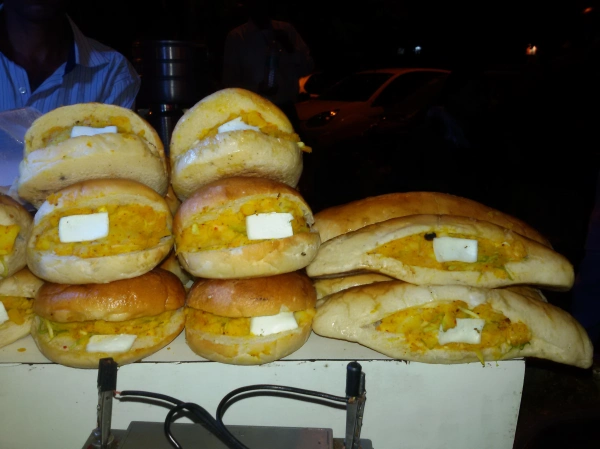
punjabi burger
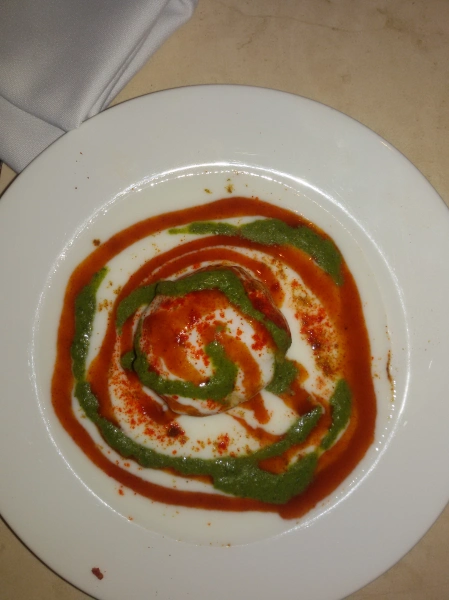
dahi balla
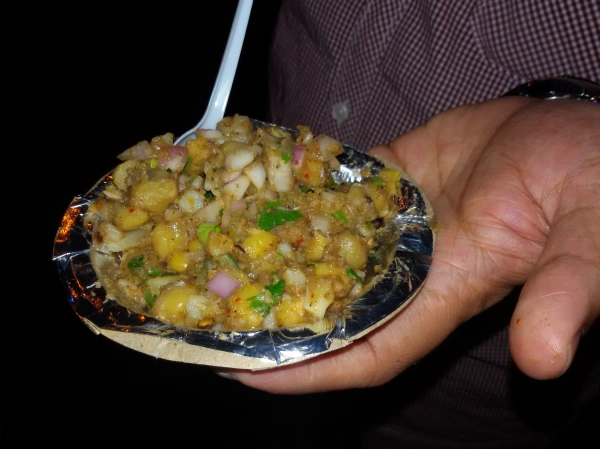
the chana to stuff into the kulcha
punjabi burger
dahi balla
the chana to stuff into the kulcha
channe ke kulche, which has a soft totally non oily kulcha which is cut into half and stuffed with some concoction made out of chanas. Really tangy and yum! There were huge tavas with ragada patties(small boiled potato patties) to be shallow fried and eaten with masala chaat. The sizzle in the tawa, being the added attraction to stand as close to the cart as possible, so you can ward off the mild chill! There were Punjabi burgers, with huge dollops of amul butter in between!You got full just looking! Even boiled American corn had a special masala on it to make it ‘chatpata’!End of the day,I definitely knew how a stuffed turkey would feel, would it be alive!
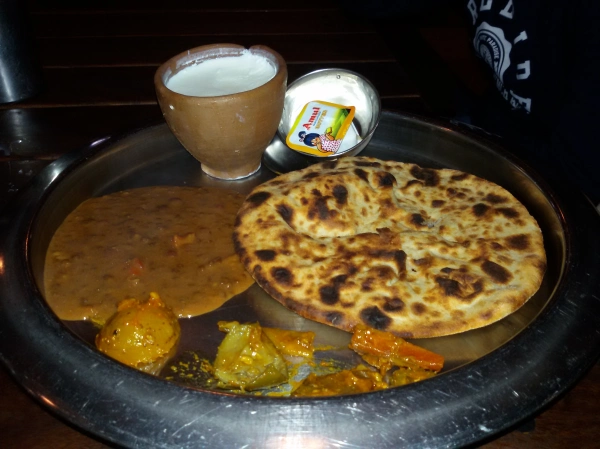
Next day, we traveled to Amritsar after a hearty breakfast of aloo paranta, daal, curd, pickle and you guessed right, amul butter!
yummy breakfast
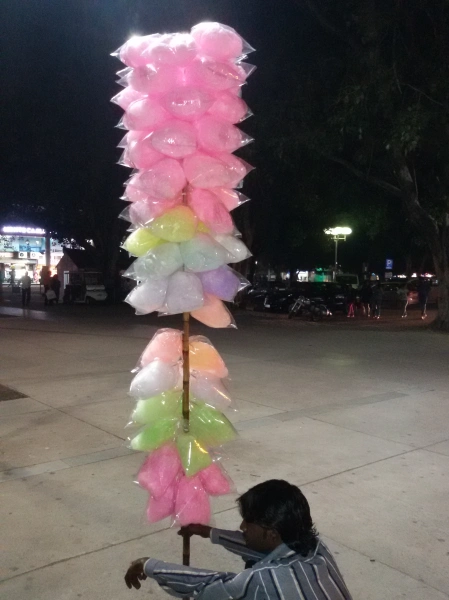
multi colored cotton candy,never seen any other than pink till now
yummy breakfast
multi colored cotton candy,never seen any other than pink till now
Amritsar is a place which makes you calm despite the chaos around you.The golden temple is located in the old part of Amritsar whose congested lanes contain tiny but awesome smelling tea stalls and saffron jalebis. Once inside the Golden temple, a sense of awe descends on you. Though it is filled with thousands of people, you do not feel the rush, and there is a sense of calmness which prevails. All the sounds of the external world wash away, and you only get to listen to hymns being sung on the loud speaker.The sparkling white external edifice, the contrast of the gold, the tranquil lake-all make for a wow experience! I have never felt so much at peace before. I can vouch for this, as my usually fidgety daughter was surprisingly quiet for the entire one hour that we stood in line to enter the gurdwara, and meekly agreed to cover her head with the head scarf given(given that on regular days, it’s a battle to even get her dressed for school!).
The prasad in the golden temple consists of a mouth watering halwa made of semolina, sugar and enough ghee almost to drip down your fingers! Any number of times that you ask for the halwa, it is given with equal grace and no zero irritation!The langar of the temple apparently feeds about 30,000 people on any given day! Despite hordes of people sitting and eating their roti, kaali daal and ghee rice, there is no noise or chaos. In a
time where we discriminate based on caste, religion and status,it feels good to see people of all types, colors and faiths sit together and receive their meal with humility and reverence.
Of the two disappointments I had in Punjab, the first was not being able to sit and eat in the langar, because we were short of time to reach the Wagah border and Jallianwallah bagh. Jallianwallah bagh is about 10 minutes distance from the golden temple. The minute you enter, you feel all suffused with a sense of patriotism which you did not know existed in you. One minute sad, and another really thankful for our independence and democracy, however corrupt it may be!
the chatpata chaat corner, a place to sell at least 50 types of saunf to eat after your meal
Outside of this place, there are again loads of street shops selling imli lollipops(tamarind and sugar lollipops), fritters of moong daal and channa, boiled sweet potatoes with a dash of lime juice and lashings of imli and chilli chutney and multiple varieties if bhel puri which seem to be popular. What is amusing is that one the one hand if there are people who are thronging to these vendors and eating, in between all this there is Macdonalds, Dominos and Pizza Hut which are eually crowded and thriving despite the only vegetarian menu. I had no trouble believing that punjabis and the visitors to punjab, do really love food!
We finally had a fantastic meal of true Punjabi food in one of our friend’s home on the last day. A fitting finale to our food, oops good holiday!In a way, probably not getting to see the border or eat at the langar was God’s way of letting us know that we would come back to Punjab again…hungry and hopeful!
yummy tummy.. you stole the words right outta my mouth
donuts in a pattiserrie
and bhel..from rags to riches…for everyone there’s something!